The COVID-19 pandemic changed the lives of senior citizens like myself and my husband. Having slogged in government jobs for several decades, we were enjoying our retirement by traveling. With the pandemic and the numerous lockdowns, our movement outdoors was drastically restricted. As the horrific year that was 2020 ended, we looked forward to a fresh year and our children decided to take us along with them on an outing to a not-so-famous fort called Gummanayakana Kote on January 2nd, 2021.
Having been indoors for about a year, we were delighted to step out into the fresh air and left the city before daybreak in our car. The previous night, we prepared food to carry with us and dusted off our trusty water cooler laying in the attic for several years. Our children decided to visit this non-descript place with a simple logic that it would not be crowded, and that we could walk around without worrying about covid appropriate protocols.
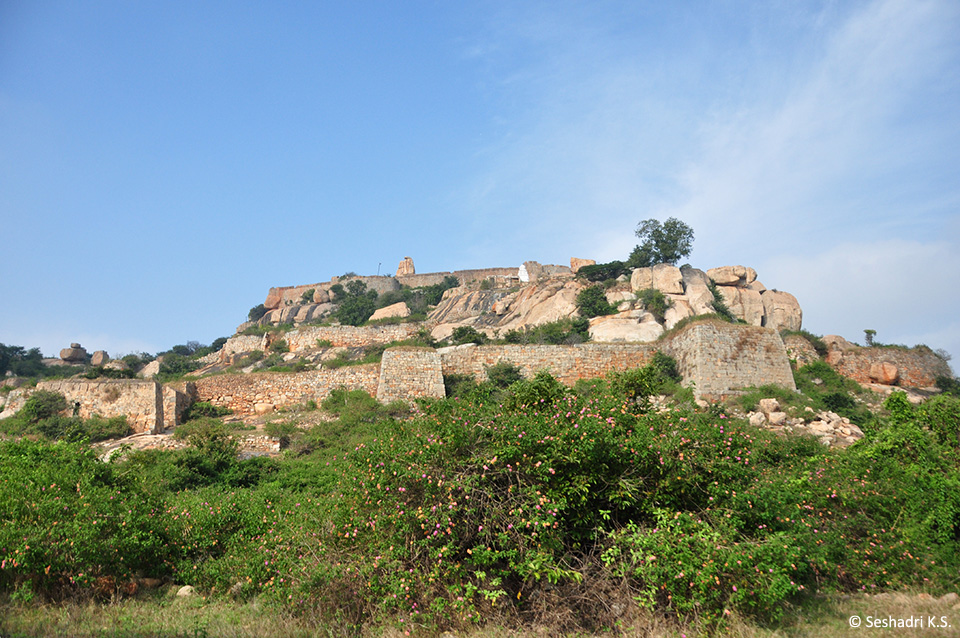
The remains of the Gummanayakana Kote as seen from the start of the trail.
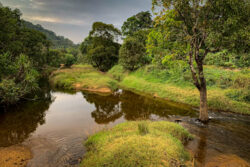
Gummanayakana Kote is located off Bagepalli town near the Karnataka-Andhra Pradesh border. En route, we were greeted by dense fog and stopped at several points to just enjoy the vista. By the time we reached the fort, following navigation on our phones, the fog had begun to lift, and we saw a quaint lake. We decided to finish off the packed breakfast by the lake and then go up the hillock.
The route up the fort was easy to find but we spent a long time observing the dilapidated structures that were strewn around at the foothills. Many of them were covered with vegetation and had marvelous carvings. When we climbed up a watchtower-like structure, we could see the long chain of hills.
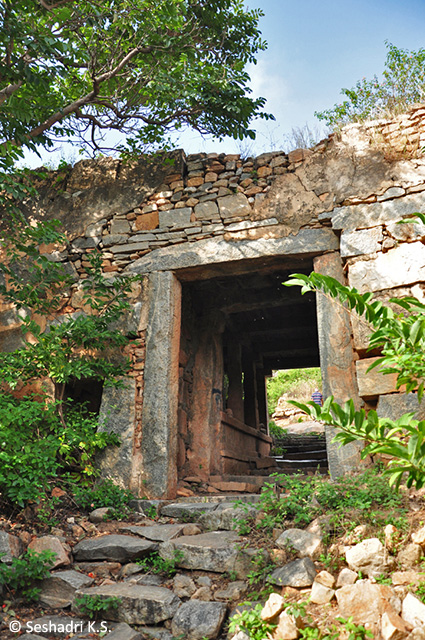
The fort was clearly in ruins. The steps leading into the wall were overgrown with plants.
Climbing up the dilapidated fort was sometimes tricky for us. We had never gone on such off-beat tracks and expected to find a well-laid-out flight of stairs. But hopping from one boulder to another had its charm and slowly, we inched up the small hillock. Along the way, we stopped to see flocks of Rose-ringed Parakeets nesting in the fort wall. We often stopped to look at the beautiful flowers that were in bloom all around us. Occasionally, we would stop and look at what we were told, was the rock agama. It took us a fair bit of time to spot the lizard as it was so well camouflaged!
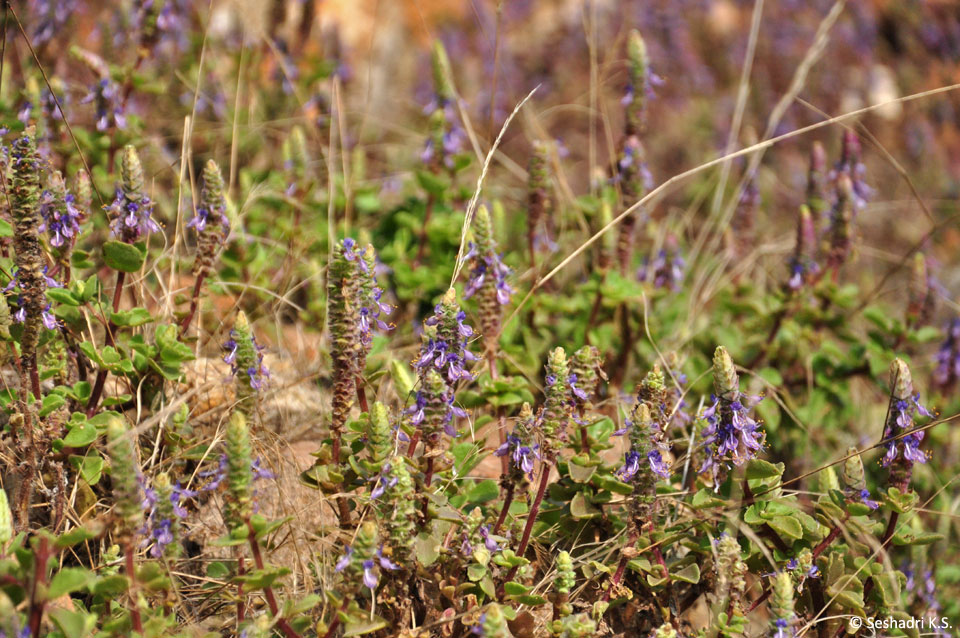
The recent rains and the lack of human activity due to lockdowns had resulted in lush growth of plants and some pretty flowers.
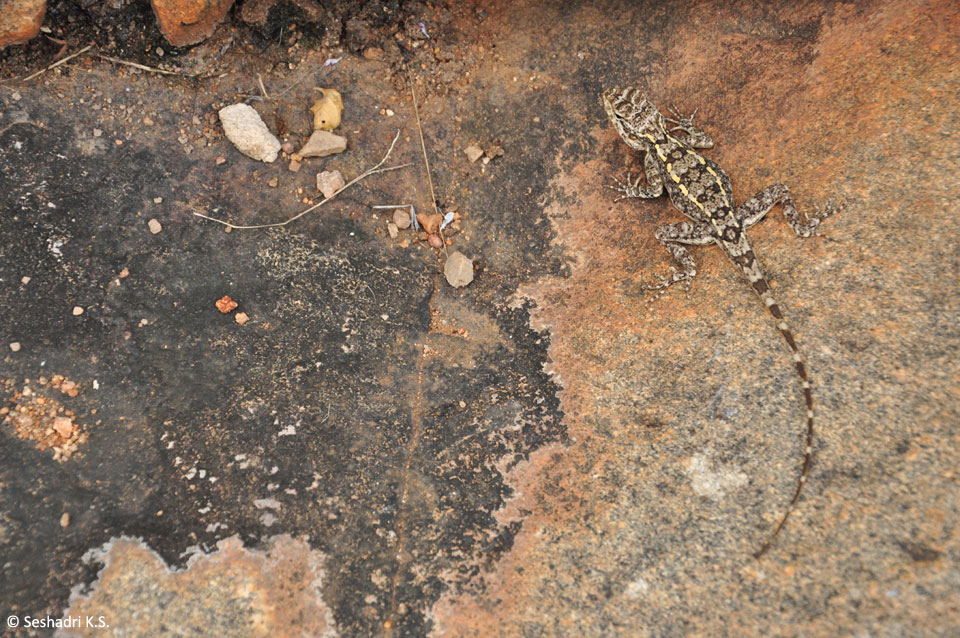
This female rock agama was likely basking out in the dappled sunlight. We saw several of them all along the trail.
Halfway up the fort, we found a little shrine and the kids went in to look for bats but came out without finding anything. A few more meters up the trail, we reached the top of the fort and went around the fort wall. It had taken us about an hour to walk up the hill at a leisurely pace. There were a few bastions and the typical viewing holes through which the soldiers presumably shot their enemies. There were buildings inside the fort walls that probably served as granaries or even armouries.
The landscape around the fort looked impressive. It was covered with some vegetation, but the large granite boulders were abundant. From this tall vantage point, we could see the village of Gummanayakana Palya and the lake where we had stopped earlier for breakfast.
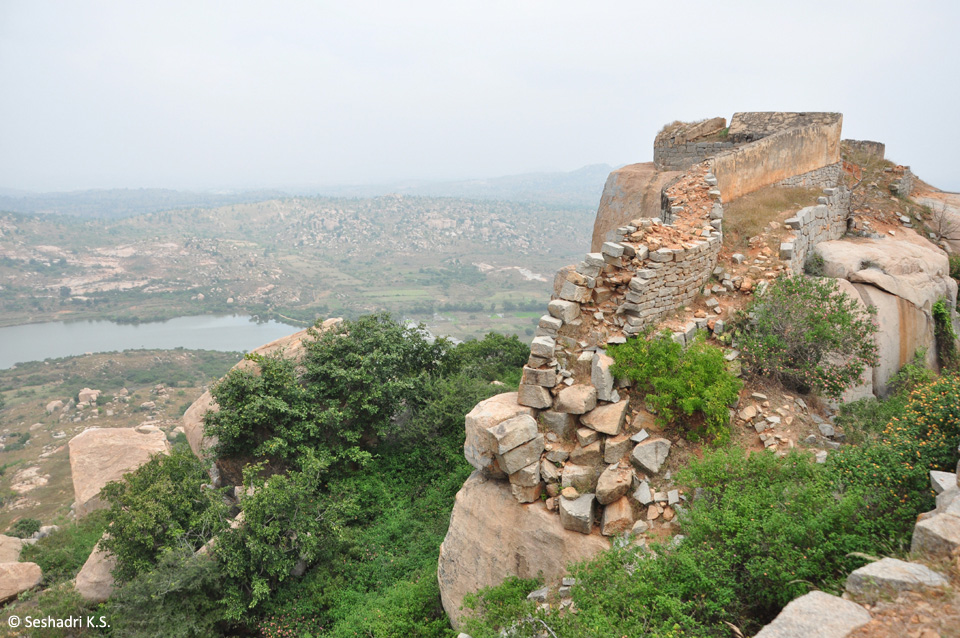
From atop the small fort, we could see a wide vista of rocky hillocks. The fort wall had given way due to neglect.
The fort complex also encompassed a lake amidst the sheetrock plateau. The plateau was broken only by a monolithic set of rocks standing tall. It had taken us an hour at a leisurely pace to climb to the top; all this time, there was no one else around but for the four of us. We two elders in the group decided to settle down on the sheetrock and take a nap.
By noon, we decided to head back down the trail and briefly stopped at the lake. We found a small group of Skittering Frogs in this isolated lake! Sadly, we also found a large pile of plastic trash left behind by people. The walls of the fort were also defaced by vandals by carving their name into this century-old historical monument.
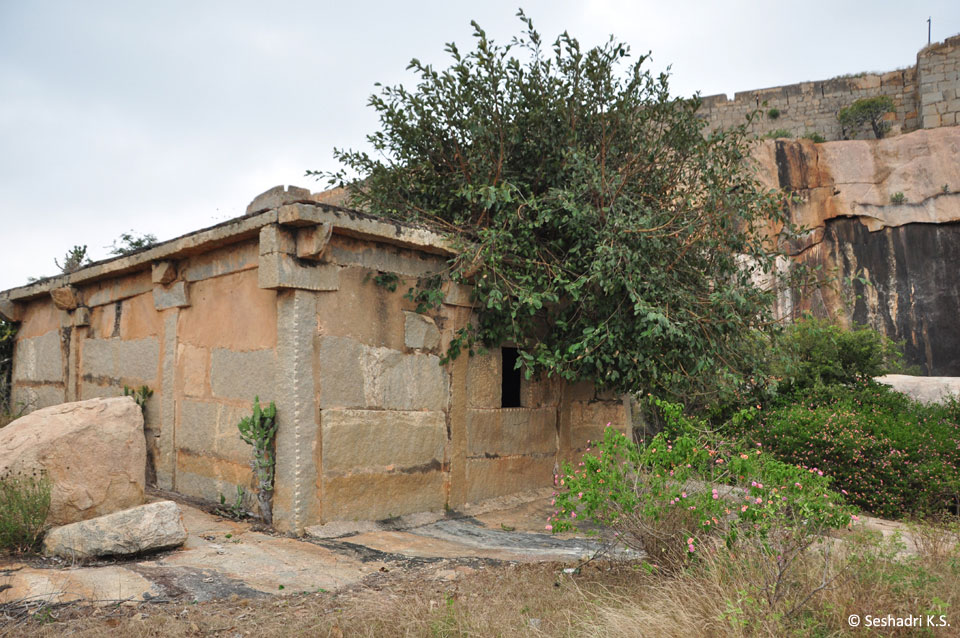
The resilience of plants was evident. This fig tree was growing out of an old building which probably served as an armoury.
Our descent from the fort was rather quick and after we hopped back in the car, we drove down to the Gummanayakana Palya village to explore another temple that was in ruins. The temple had a board put up by the Archeological Survey of India warning people against misusing the place. However, the temple was being used as cattle shed and perhaps for other illegal activities.
The walls of this ruined temple had wonderful carvings including those of animals. A little farther from the temple was an old stepwell which also, unfortunately, was in ruins. We also discovered that there is a government guest house near the base of the hillock. We returned home reminiscing the half-day outing, with plans of returning another day and spending a full day exploring the fort.


Instagram
junglelodgesjlr