In the Forest
The day begins early – from just about sunrise – for both of us. Having an early snack and carrying a backpack with food and water is required for the long day’s walk. Expectations are not always high for me and my tracker, as we can never really be sure of finding them. To track Lion-tailed Macaques (LTMs) in the forest needs a thorough understanding of maps of the distribution of both the forest and the vegetation; also, knowledge of their plant species usage and fruiting areas of that species are important clues. Sitting quietly on an elevated hillock with ears wide open to catch their ‘coo’ call, or loud screeches from an occasional disagreement amongst members, or a cry from a weaning immature for its mother, are many a times of great help to zero in on their location. Minute cues such as partially eaten fruits fallen on ground, or their feeding on certain bushes provide important information on the time of their presence in that area. In the undulating terrain of Western Ghat forests, it is literally an uphill task. All the odds are against us in these low elevation evergreen forests with high humidity, temperatures and rainfall making it a very tiring slog. The only solace is that once found, LTMs allow us to stay close enough until dusk, when we leave them with the hope of finding them again at dawn.

Aghanashini valley is characterised by its high diversity of flora and fauna
I noted down minute details of their feeding and collected their ranging data for ten days a month. With more than 1200 hours of observation, we observed > 70 plant species and many varieties of animals eaten as food. To achieve this degree of habituation, it demands mere patience and perseverance – following the same group all day for several months, until they ascertain that you are not a threat. The duration for habituation is very specific to each group and their exposure to humans. We learnt to wear same-coloured outfits and to completely avoid eye-contact during habituation. A direct eye contact and an imprudent move are perceived as threats, which may disrupt our follow for days, as they might completely start avoiding us.
Welcome to the world of the majesty of the evergreen forests: the Lion-tailed Macaques (LTMs).

The Lion-tailed Macaque is one among the fifty ‘Amazing Species’ as listed in the Red List of Threatened Species (http://50.iucnredlist.org/species/lion-tailed-macaque)
What Happened Earlier
It all began with strong initiatives by the Karnataka Forest Department to have a detailed scientific study on the status of LTMs in Sirsi-Honnavara forests in the Aghanashini valley. Studies confirmed that the area possessed >30 troops, with an estimated 650 individuals, one of the largest populations in the world. They have known to be highly threatened globally and have received high priority for conservation. They are facing an imminent danger from habitat loss and fragmentation. Timely initiatives by the government led to the conservation of ~300 sq.km of forest, which was notified as ‘Aghanashini Lion-tailed Macaque Conservation Reserve’, with Lion-tailed macaques as the flagship species.

Human colonisation has made permanent changes to the forests of Aghanashini valley due to expansion of built-up areas and agricultural lands, especially around valleys
But all is not over yet, with merely its notification as a protected area – efforts have been initiated to manage the area based on sound scientific research to deal with need-based, site-specific issues. The reserve is populated by a large human population which is highly dependent on forests for subsistence, including non-timber forest produce (NTFP). It has been documented that about 70% of the NTFPs are food of Lion-tailed Macaques. Some of the important species are Garcinia gummi-gutta (Uppage), Myristica malabarica (Ram Pathre), Myristica dactyloides (Sann Pathre), Calamus twaitessi (Handi bettha), Calamus pseudotenuis (Halbettha) and Artocarpus lakoocha (Vaate).
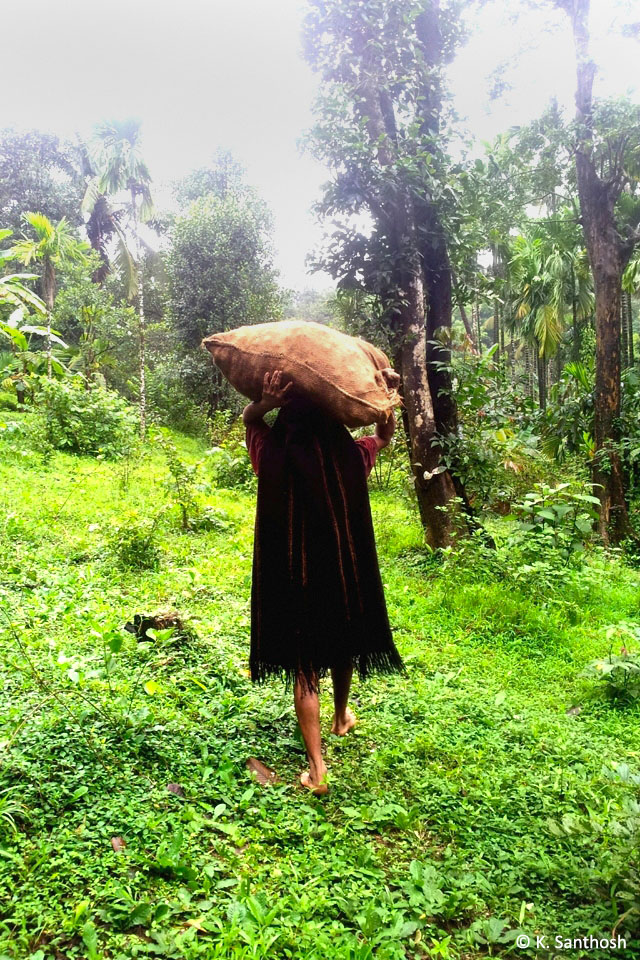
Majority of the yearly income of people in Aghanashini derives from collections from forest
The Road Ahead
Having known about the high dependency of people on resources and their overlap with monkeys, what options do we have in front of us? Can we ban resource extraction? Or do we allow the resource to be over-exploited, irrationally succumbing to market pressure? There have been several examples from around the globe, where conservation efforts have failed in instances where the interests of local people have not been met in the process of policy-making. The fact that the local people are important stakeholders in the decision-making in many parks does not remain a secret anymore.
Efforts have been made to devise a model for sustainable harvest of resources. Uppage fruits are one of the major resources extracted widely, generating a large amount of income for people. The devil-in-hiding is the drying process before selling Uppage in markets – this processing greatly impacts consumption of firewood, which has historically been procured by people from the forest easily. An estimated use of ~80 lakh kgs. has been one of the pivotal reasons for the present conversion of 1.9% annually of evergreen forests to a degraded state. The innovation of energy-efficient ovens and their usage for processing have documented up to 80% of reduction in fuel wood, throwing light at the end of the tunnel. In the future, initiatives need to be taken up for distribution of these energy-efficient ovens to every household which processes Uppage. Restoration of degraded areas has already been taken up using both fodder species for Lion-tailed macaques and species of economic importance to people.

Uppage is dried in open fire ovens using large quantities of firewood, and is highly valued for use in the pharmaceutical industry for extracting HCA, an anti-obesity drug
Additionally, at the policy level, elimination of middle-men in trade of forest produce has been highly suggested. It is important to restore the confidence of people in a multi-stakeholder society which should reserve the powers of auctioning forest produce to the consumer industry. If done at a large scale, it may regulate the black market and ensure the sustainability of resource extraction. The key here remains that the policies have to be made consistent with neighbouring forest divisions, to be highly effective.
There are quite a number of examples worldwide, on how protected areas have just remained ‘Paper Parks’ due to handicapped policies and inconsistent commitments at the grass-root level. The most important thing to note here is that if a conservation effort is backed by stringent policy-making based on ground research, it may make a great deal of difference to the species in focus. The Aghanashini Lion-tailed Macaque Conservation Reserve was formed by the sustained efforts of Karnataka Forest Department based on scientific knowledge and support from a wide array of people like activists, wildlife enthusiasts, administrators and local people. However, the job is not completely done – the challenge for the future remains in imposing the policy on the ground, taking all the stakeholders into confidence. This may be the effort required to save the northernmost population of Lion-tailed macaques and its habitat.

Cane (Calamus sp) is used for making baskets of different sizes, a commodity of importance for every agriculture-based household
Back in the Forest
When the feeding study was about to wrap up for the season, one day on a hillock when we were trying to locate the group, I was jotting down research questions for future studies. I was digging into my data-book for some of the interesting things I had noted down in two years, about these fantastic animals. I was trying to connect the dots to understand some interesting patterns I found during the study. I had a lot of questions in mind and was trying to add possible conclusions to them. At that juncture, I was asked a question by my tracker, which seemed to have bothered him for a long time “why are these monkeys called Lion-tailed Macaques, as it seems more sensible to have named them Lion-maned Macaques?”
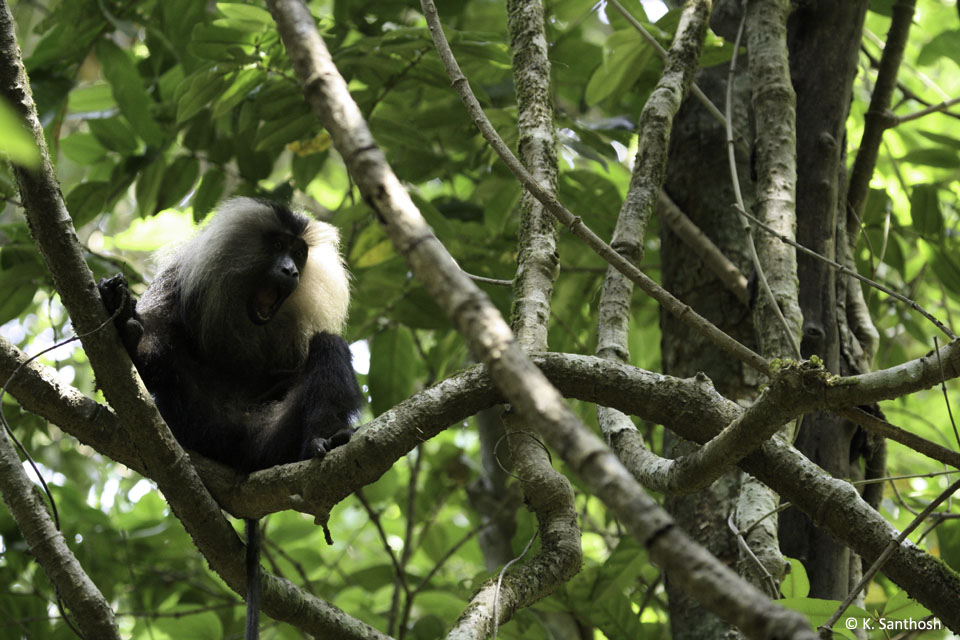
LTMs are highly interactive with other group members, communicating through their characteristic ‘coo’ calls which help us in locating them in the dense forests
Even as I tried to muster up my opinion after a long thought, he was already looking at the sunset, ready to walk. With a lot of questions in mind that needed answering, I quietly followed him as we paced quickly towards our camp before it became dark.




Instagram
junglelodgesjlr