It was an amazing moment in October 2014 when I had my first sighting of a black leopard in Nagarahole National Park. Until then, there was no record of a black leopard sighting in the park for the last 30-32 years. It looked like a black patch of wood up on a tree, almost like a burnt branch. We turned around, as we wanted to see it from a different angle, and saw legs and a tail hanging from the branch. We stopped our vehicle and it was a black leopard indeed! I was awestruck and took some time to realise that I was actually looking at a black leopard. Our guests were happy and took many photographs with curiosity and excitement. That has been an unforgettable day for me. That is the day we realised that there is a resident black leopard at Nagarahole National Park.

Commonly known as the ‘black panther’, this is the melanistic form of the Indian Leopard (Panthera pardus). It is not a separate species but rather the same species with a gene that produces dark pigments – melanin. Therefore, such dark individuals are called melanistic.

The black leopard is dark in colour – it doesn’t mean that they don’t have spots; the spots are just harder to see. When the coat catches sunlight in a certain direction, we can see their spots very distinctly from a distance. If there is no direct sunlight on the skin, it will look like an animal with a solid black coat.

Like all leopards, black leopards are very shy too. The black body and yellow eyes can make them seem frightening to some people as compared to a leopard of normal colour.

Being just a melanistic version of the leopard, one should expect them to climb trees too. I think its amazing to see them up on a tree. They weigh up to 60-70 kg and live up to 12-15 years in the wild. Normally, black leopards are found in rainforests and in the Western Ghats, but rarely found in dry-deciduous forests like Nagarahole, Mudumalai and Bandipur, though there have been sporadic records.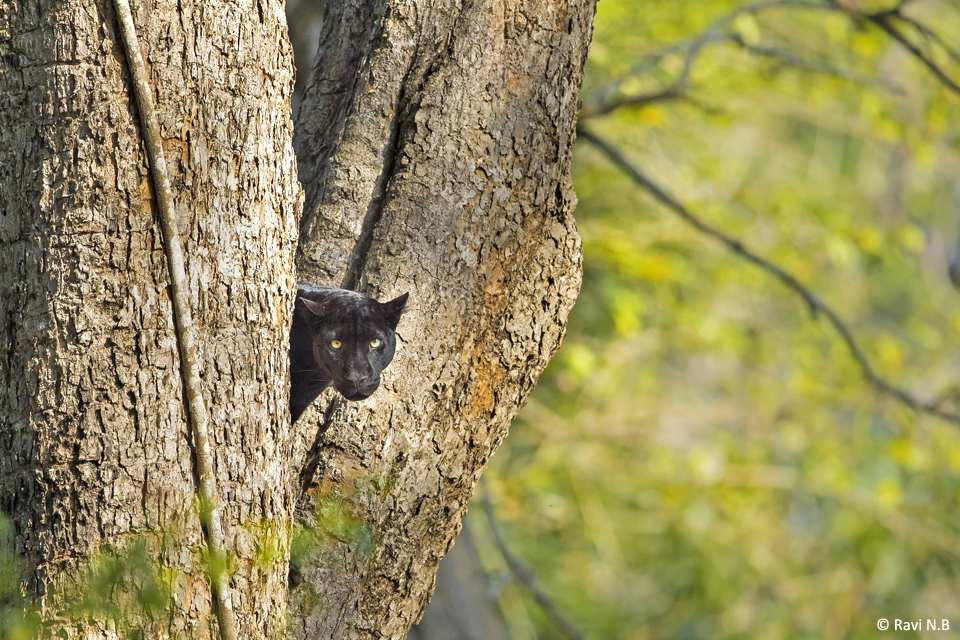
The hunting behaviour of leopards is very interesting, and they stalk and hunt like other big cats. They also hunt on top of trees and on the ground. They prefer small mammals like monkeys, deer, wild boars, birds and small reptiles. They normally store their food up on a tree, to protect it from other big cats and scavengers.
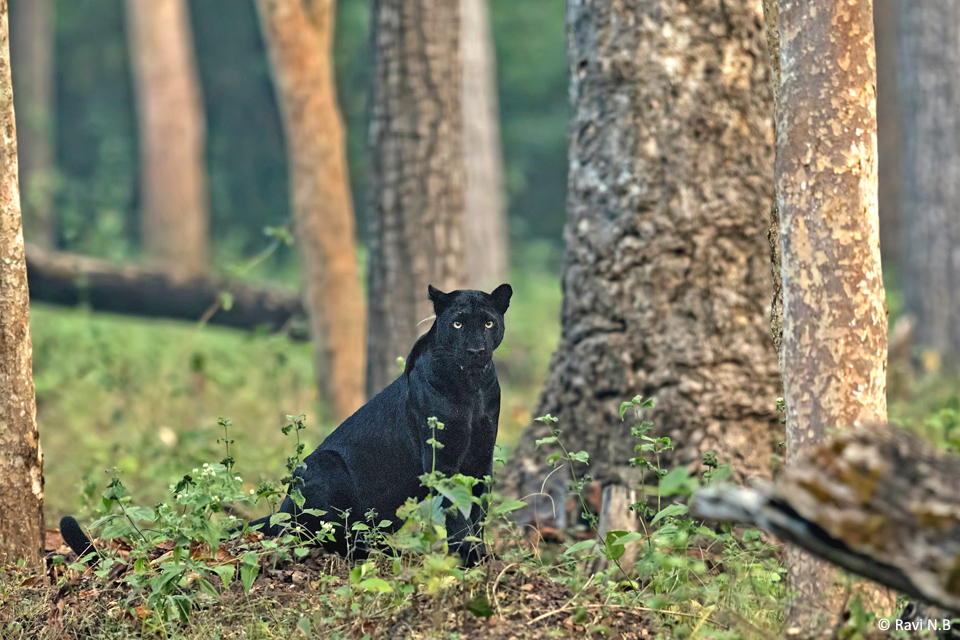
As of now, there is only one black leopard walking the forests of Nagarahole National Park and his territory is in the tourism area. Like other leopards, he scent-marks his territory, scratches on trees and scats on the ground. This male has also been seen courting female leopards, and has fought with other male leopards for dominance. He has possibly mated with 3 or 4 female leopards since last October. And now we hope to see some cubs as well!



Instagram
junglelodgesjlr