Vena Kapoor interviewed Prof Anindya Sinha, known to many of us as ‘Rana’, for JLR Explore. Rana currently works in the National Institute of Advanced Sciences (NIAS) and has been studying, in addition to elephants, dolphins and other primates, Bonnet Macaque troops in the forests of Bandipur for almost two decades now! Here, he regales us with his journey, why he thinks these animals are fascinating, why we should care about them, what keeps him motivated, and all the interesting research he is carrying out. He also has a very important message for all of us, so read on!
Vena: Rana, tell me a little about how you got to studying Bonnet Macaque behaviour, because I heard your degree was a PhD in Molecular Biology! Give us a bit of a background.
Rana: I’ve always loved nature, being outdoors, the fresh air and the trees. Very early in life I was fascinated by biodiversity and the variability of life forms, and developed a deep passion for watching people and animals; I also quickly realised that I was happiest while doing this.
Due to various circumstances, including, I guess, not knowing that I could actually pursue research on animal behaviour, I ended up doing a PhD in Molecular Biology. Once the new world of animal behaviour opened up, molecular biology seemed a bit restrictive and reductionist for a person like me who wanted to be “out of the lab”. I started experimenting with and doing more of idea-based research. Also, unlike many of my peers at that time, I never really wanted to go abroad to study. I knew that I wanted to always be here, where my friends and family were, and work in India.
I decided to work on how people think, and really get into their minds. There were very few studies on the evolutionary biology of the mind at that time. I was also very interested in understanding the mind of nonhuman species, specifically primates in the wild, because that would give us insights into how our minds came to be what they are today. I came to the Indian Institute of Science (IISc) to work at the Centre for Ecological Sciences (CES).

Vena: Is this when you got interested in primate behaviour specifically and started your work on this?
Rana: My first stint of formally observing and learning about animal behaviour was when I worked on social wasps in CES. Two of my favourite books that really influenced me at that time were Konrad Lorenz’s ‘Man meets Dog’ and Jane Goodall’s ‘In the Shadow of Man’. Looking back, I truly believe that these books in some way convinced me to follow my heart; I still strongly believe that one gives his or her best when one follows their passion and does what one wants to do the most.
After my stint at IISc, I realised that I wanted to formally study social cognition and took up a position at the National Centre for Biological Sciences (NCBS) to study animal behaviour, specifically the resident Bonnet Macaque populations living on the GKVK campus of the University of Agricultural Sciences in north Bangalore. I studied the troops there for more than three years. My first peer-reviewed article on this work was published in the Philosophical Transactions of the Royal Society, London and I was over the moon, not just because it was a good and prestigious journal but much more importantly (for me at least) as it was the journal in which Charles Darwin published his work!
Vena: That’s really fascinating, Rana; not many people find their true calling. You not only found it but you are one of the most famous researchers on animal behaviour in India today.
Rana: What kept me going and motivated me was that I really believed, and my data and observations also thankfully showed me, that there was a tremendous variability in the behavioural profiles and cognitive abilities among the individuals in a population. And so while community ecology and population ecology were becoming important to understand a species across geographical areas in general, I truly believed that it was extremely important to also study the variation among individuals within and across populations of a species (known as Intraspecific Variation). Individual Bonnet Macaques were learning through their experiences, adapting to their particular environments, and forming unique social groups.
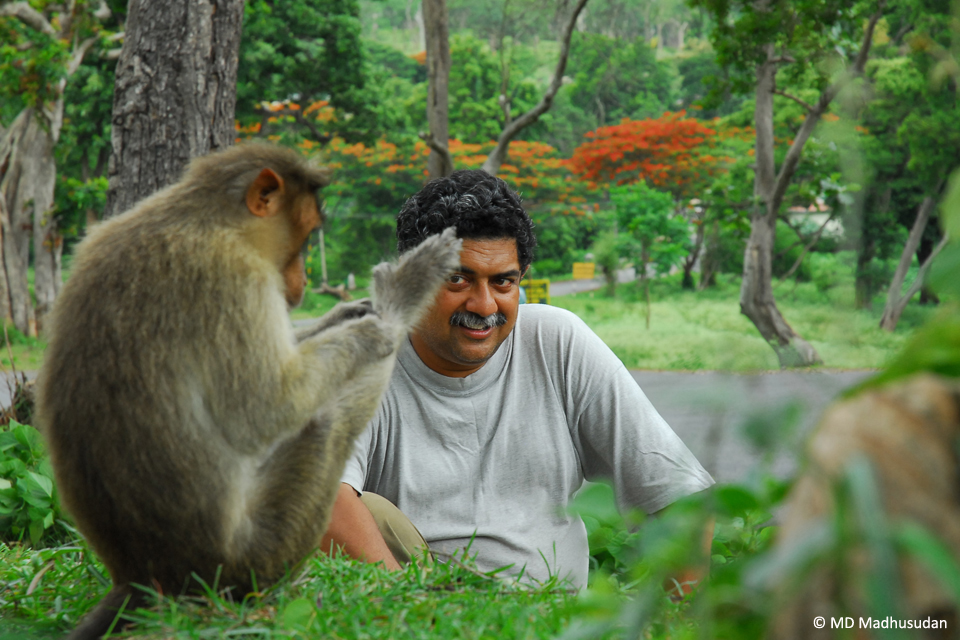
After a few years of research, I realised that the GKVK populations were becoming a bit restrictive for me to study the evolution of social behaviour and cognition over long periods of time. I therefore made a choice to move my study site to the forests of Bandipur in Karnataka in the year 2000. Interestingly, I was also asked to leave the GKVK campus at that time by the authorities, who believed that I was attracting unwanted monkeys to the campus! Bandipur was an extensive forest and harboured a large population of macaques, just right, I thought, for meaningful, long-term studies of the kind I wanted to do.
Vena: So that brings us to the core of your research and findings on Bonnet Macaque behaviour.
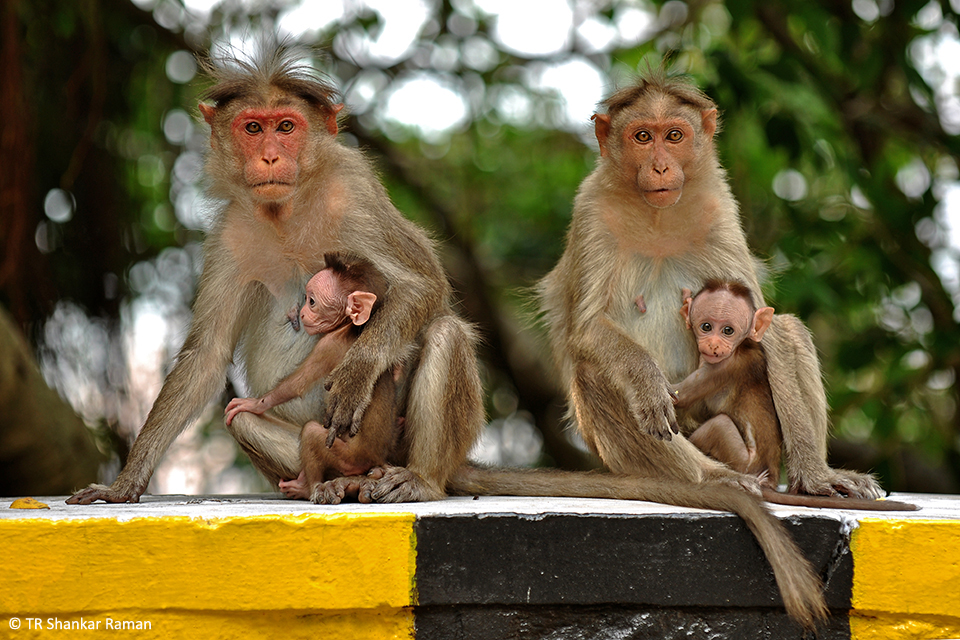
Rana: For almost 18 years now, I have been following over 1800 individual Bonnet Macaques in their home, Bandipur. Over this time, we were amazed to discover two distinct kinds of troops in this population – the multimale troops, with several adult males and females, and their dependent young, and the unusual unimale troops, with a single adult male, a few adult females and their young. This wonderful discovery, along with the realisation that each individual in each of these troops was unique, in appearance, short-term behaviour or their long-term life-history strategies, came about with my close friend and long-time research collaborator, Kakoli Mukhopadhyay. Our twin children were often part of our research as well, from the age of two years till they were about sixteen, most of the time during their summer breaks from school!

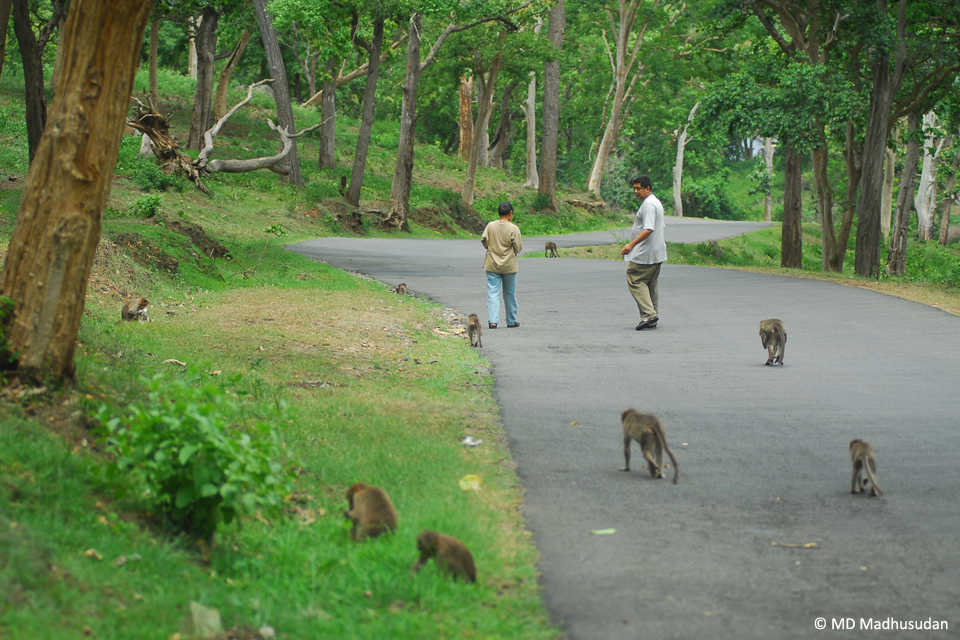
The crux of the story of my research, especially why the unimale troops seem to have evolved from the multimale troops in Bandipur, actually comes down to the people, particularly tourists visiting the sanctuary and how they interact with these macaques; the tourists pass on and throw food to these animals – and all this seriously affects the behaviour and social order of these sentient beings.
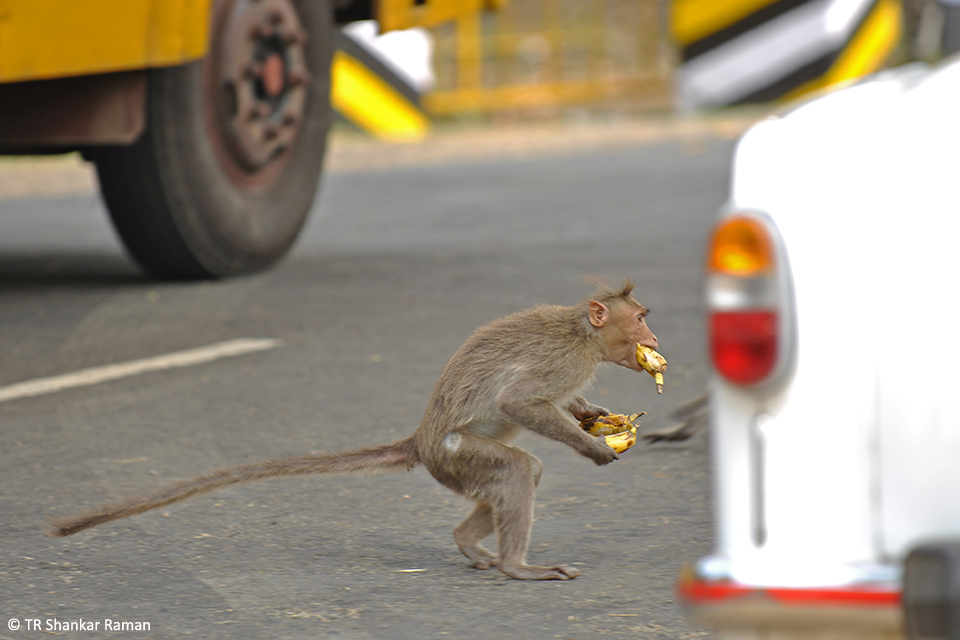
What happens, briefly, is this. The ready availability of rich, but patchy, food given by the people leads to severe aggression within the multimale troops, and they break out to form smaller associations. They then move on to occupy neighbouring home ranges. These smaller groups of females are often taken over by solitary, aggressive males and the unimale troops are born. What is fascinating is that the individuals in these two types of troops lead very different lives in terms of their friendships, enmities and even sexual relations. But what makes it very difficult, and our research specifically shows this, is that these troops are much more unstable and vulnerable to natural and human-caused disturbances. A single accident caused by rash driving on the highway that runs within Bandipur or an act or two of predation by leopards can almost wipe out an unimale troop, they thus do not last long and die out, often rather quickly. When we cause the death of a macaque with a protected area, it is indeed tragic. But, what strikes me more is this – are we destined to decimate entire troops of macaques, simply because they become dependent on us for their survival, where they move out of the forests to line up along the roads, waiting to be fed and sometimes ultimately killed?
Vena: On this note, I believe you also have an important message for all of us?
Rana: If I have to summarise these findings of ours, I would say that the “simple benevolent act of feeding monkeys by people, either through believing that this is an act of charity, or that these monkeys are reincarnations of the god Hanuman, or that they will attain salvation in their afterlife is what is, ironically, causing the greatest damage to these macaques…”.
So, more simply put, when we feed these animals with all good intention, we are actually messing with the natural ecology of the species because these animals are being provided with food all through the year now. The analogy I can think of is akin to cutting down a tree and disrupting a whole cascade of natural processes – you lose a unique individual and all the unique functions and processes that go along with that particular individual. You disturb a whole web, to which that individual contributed significantly, the world changes for ever.
Vena: That’s indeed food for thought! I used to be in two minds about people, especially tourists, feeding macaques. I used to think that this was a way people were empathising with animals and that with empathy would come protection – clearly it is much more complicated than that!
Rana: Yes, I really think that it’s terrible, what we are doing to these individuals – the tragedy, as I said earlier, is, of course, that we are well-meaning and do not realise what we are doing. But perhaps we can follow the simple instructions that the Forest Department gives us? Please do not feed the monkeys or any animal in the forest, for that purpose.
Vena: Tell us a little more about your research work and your findings from this long-term monitoring of Bonnet Macaque populations.
Rana: I think the most important aspect of our work, academically, is that we are trying to establish the individuality that characterises all living beings, including the Bonnet Monkeys of Bandipur. What we have also been able to study are certain unique processes at the level of the population, namely the establishment of different cultural traditions in this population. Whether it is washing wild mangoes in the river Moyar, raiding cars for food, juveniles requesting food from tourists using certain gestures and calls or male juveniles trying to carry infants like their mothers do, we have now seen certain troops display certain behavioural patterns that are uniquely theirs and which seem to have spread within the troop through social learning. While such cultures are well known in apes like chimpanzees, our study has shown that even monkeys may have behavioural traditions – culture is evolutionarily much more ancient than we earlier thought!
Philosophically, I think one of the very important lacunae in our thinking about the nonhuman is that we have completely disregarded the idea of individuality. As (Stephen Jay) Gould said, so elegantly, “Biology is the science of the variance, not of the means…”. I realised long ago never to neglect the outliers, no matter what else my data pointed to, because these irregularities made my research that much more exciting. Thinking about it further, I would say that this is true for life as well!
Vena: Can you also tell us some stories about specific individuals you have studied over the years?
Rana: Another aspect of our work that I find so fascinating and exciting is that we often see certain individual macaques make complex decisions, based on their experience, knowledge and learning. I’ll give you an example to illustrate a remarkable event that happened in front of our eyes. There was a small troop, Troop A, consisting of two adult females and two adult males, close to the Bandipur National Park reception area. The older female had an infant. One morning, two young, handsome males arrived at the periphery of the troop from somewhere – we had never seen them before. The older adult female left her four-month-old infant, and came down the tree she was on to interact with these two new males. After about 15 to 20 minutes of interacting with one another, to our great surprise, the female and the two young males simply left the troop and proceeded to walk almost 2 kms away, to the periphery of another troop, Troop B. They hung around together for the next few days, during which time the three individuals interacted extensively with the members of Troop B. Soon after, one of the new young males left the area and disappeared completely. After about three days, our Troop A female and the remaining young male suddenly walked back to her old troop, climbed the tree while the male waited below, collected her infant, descended from the tree and the three of them now walked back to Troop B, which they then joined stably.
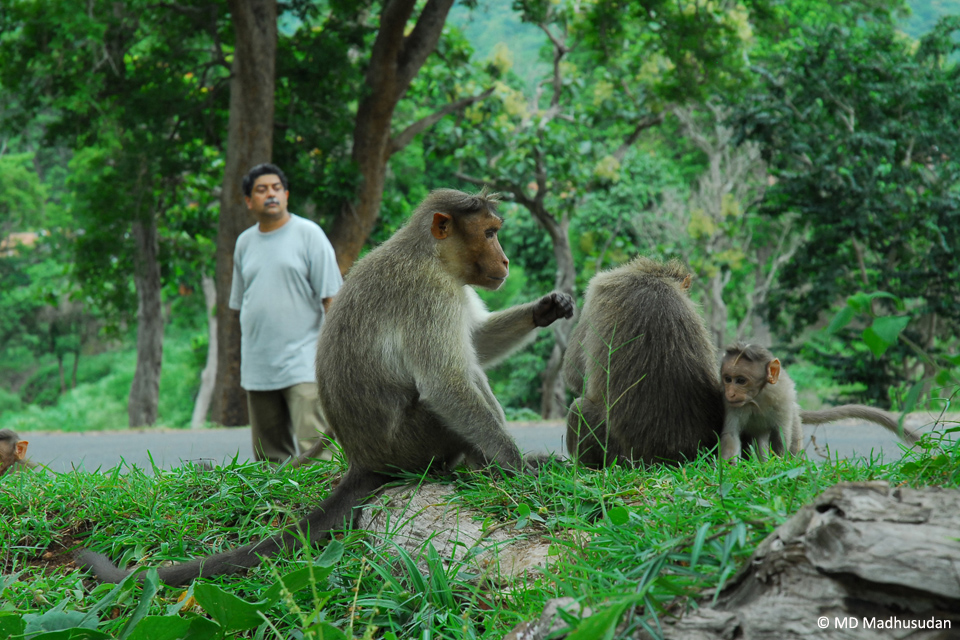
Clearly, this incident showed us that the adult female had made several important decisions, remarkably complex ones, and I continue to try and understand how these behavioural responses were taken, how much of future planning did they involve, what circumstances push individuals to make such decisions, and how these decisions affect them and the troops they are with.
Vena: So what’s next, Rana? Do you have any new research work on the cards?
Rana: Ah! I have an exciting new multi-institute, multidisciplinary project on urban nonhuman ecology with a colleague in Cambridge University, UK, which I am really looking forward to. We plan to explore animal lives in the city that involve the cultivated – cows, for example – the feral, represented by street dogs, and the wild: groups of macaques, for instance, whose lives are changing drastically with urbanisation, often threatening their very survival. We want to understand how animals navigate the city and its people, carving out independent lives for themselves and also hope to develop new insights into how our cities need to be managed in order to ensure the welfare of its human and nonhuman denizens, increasingly forced into an unhappy coexistence.
I am also deeply interested in cultural and performance studies in theatre and music. A new project that I have initiated concerns how marginalised communities are able to express themselves and carve out their unique identity through art, music or theatre. In this connection, I plan to study the temple elephants of Kerala and their associated human communities, struggling to survive and maintain their traditions in the face of increasing urbanisation – what lies for them ahead? And so, you can see that I am moving beyond my ken once again, and my adventures in the social sciences have begun. But then, biology is a wonderful universe to be in, from molecules to minds, from individuals to communities, from the natural sciences to the social sciences!



Instagram
junglelodgesjlr