If you are looking for a Madras Tree Shrew, one of the worst places to search for it, strangely, would be Madras! Instead, you would do better stalking every squirrel-like animal in South India’s tropical forests to see if it looked or behaved any different from the more familiar urban and village rodent. And one of the best places to get a good look at this remarkable creature is the Biligiri Rangaswamy Temple (BRT) Tiger Reserve in Southern Karnataka, right on the border with Tamil Nadu.
BRT is famous for its wildlife – tigers, elephant, gaur and sloth bear abound here, among other species. The birdlife of the area is spectacular as well, with almost 300 species found here, including some species, like the Malabar Parakeet, that are found only in the Western Ghats, and nowhere else in the world. But although the bigger and noisier of the animals and birds take up most of our attention, there are other creatures just as interesting hiding in plain sight.
Surprisingly, the first time that the Madras Tree Shrew was noticed (as being a tree shrew at least!) in BRT was only in 2003. Surprising because the Soliga tribe has lived in this area for centuries, and knows the wildlife here intimately – but perhaps not expecting this animal to live here, nobody thought to ask them about it! Surprising also that no less a keen observer than RC Morris, who lived in BRT from the late 1890s to 1955, and wrote authoritatively about its fauna, didn’t notice this animal.

Madras Tree Shrew Anathana ellioti
But maybe that is somewhat understandable. From a distance, leaping along a stream bank, or bounding through root tangles and low shrubs and branches, the tree shrew looks almost exactly like a squirrel – no wonder then that the scientific name for tree shrews comes from the Malay word for, no prizes for guessing – squirrel. And despite its name, the tree shrew actually prefers hanging about on the ground, looking for choice morsels like plump worms and juicy insects. Madras Tree Shrews (also called Indian Tree Shrews) are reddish-brown in colour, with grey tinges on the head and both fore and hind legs. Unlike a squirrel’s, the face is pointed, the tail is not as bushy, and ends at a point. Its ears are tiny copies of human ears, with all the little nooks, crevices and folds. Here’s a simple identification guide – if you see a brown squirrel that is pointed at both ends, and looks like it’s listening to you, it is likely to be a Madras Tree Shrew! One more key ID pointer is that tree shrews hold their tails up when they walk unlike squirrels.
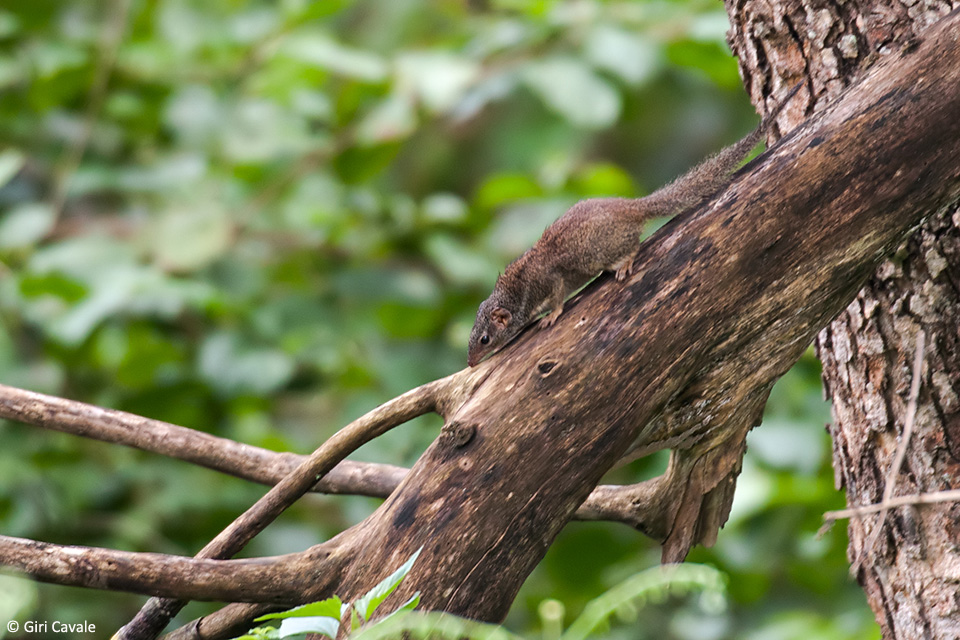
And tree shrews are certainly not just sharp-ended, high-tailed squirrels. In fact, they are more closely related to primates (monkeys, apes and us!), and are so special biologically, that they merit their own order in the classification of animals – to understand how special this is, imagine that if you went on a safari in BRT and saw wild dogs, two stripe-necked mongooses, a leopard, a tiger, a small Indian civet, and then a bear, you would have seen representatives from only one mammal order. Then, entering K. Gudi, if you saw just one tree shrew, you double the number of orders sighted!But there is even more that is special about tree shrews. The Nicobar Islands (south of the Andamans) are home to a close relative of the Madras Tree Shrew, predictably named the Nicobar Tree Shrew. This species, small and vulnerable to being eaten by birds of prey though it might be, strikes up partnerships with sparrowhawks and Racket-tailed Drongos to forage for food, sometimes feeding as close as 6 metres from the sparrowhawk! Truly, behaviour that is unique in the animal kingdom. And perhaps not surprising because of their relatively close evolutionary links with humans, one species of tree shrew is the only known wild animal that regularly drinks – alcohol! Every evening, the pen-tailed tree shrew seeks out the fermented nectar of a palm species found in the jungle. In fact, in one night, a single tree shrew can consume what would be equal to two large bottles of beer without any side effects – more than the quantity some humans would be able to handle!
In BRT, though, we are barely scratching the surface of how these amazing animals behave in the wild. Although they are not likely to indulge in drunken binges like their Malaysian relatives, the fact that they are sighted over and over again in the same areas might mean that they defend permanent family territories. Also, because they are also often seen roughly at the same time in the same place, they might also have a routine ‘beat’, like a Bengaluru Hoysala.
Some of the places in BRT where tree shrews are regularly sighted are at K. Gudi (very close to the Jungle Lodges area), Basavankadu (the stream with a bridge on the road from K. Gudi to the Biligiri Rangaswamy temple) and the Durgur safari road. So the next time you are at BRT, look out for these energetic and enigmatic creatures, and you might be rewarded with an interesting tale or two.



Instagram
junglelodgesjlr