This place called Agumbe…it has a charm…and it will absorb you! Come June, and monsoon clouds descend on these hilly regions of the Central Western Ghats. Hues of grey and green dominate the landscape with a mosaic of tiny speckles of other colours too. Time seems to relax here and everything moves at a pace that soothes the senses and mind. Thick clouds of mist are an invitation to a game of hide and seek; for a moment everything is clear and in the next, it hides everything in its path. A waft of fresh air tingles the nostrils, and the musical intonation of people’s accent in the region is warm and welcoming. The silence here can redeem or kill; it is a call to one’s inner voice to listen within.
Agumbe may be known for its scenic spots, as a great location for romantic movies, as a setting for ‘Malgudi Days’ – a fiction novel that came to life, or as a sleepy town of retirees. For reasons galore, it is hard not to submit to nature here. At 650 m above sea level, these mountain ranges have been an inspiration to poets, artists, and scientists alike. Most part of its land is covered by forests, and with rains upto 8000 mm every year, it sustains, rejuvenates and replenishes life across Southern India. Three major rivers – Krishna, Cauvery and Tungabhadra – are part of these mountainous ranges of the Western Ghats.
 Agumbe is part of the Western Ghats – one of the prominent biodiversity hotspots of the world.
The words rainfall, malnad, Western Ghats and Agumbe are incomplete without ‘King Cobra’. Kingdoms are known for their kings and it is but natural that Agumbe is known as the homeland of King Cobras. Reverence for the snake comes first, and till date, King Cobras enjoy protection by people here like nowhere else in the rest of its ranges across the country. That the King Cobra is the longest venomous snake in the world, is the only snake among the 2800 species around the world to build a nest, and is cannibalistic in nature are facts for the modern scientific minds which need tags of singularity or fame to conserve it. But to a common malnad citizen, these snakes are their pride, their god, whom they revere and pray to for the wellbeing of their people and land. Colloquially known as the Kālinga (pronounced as Kaalinga), tolerance for this snake is deeply woven into this society for eons.

King Cobra
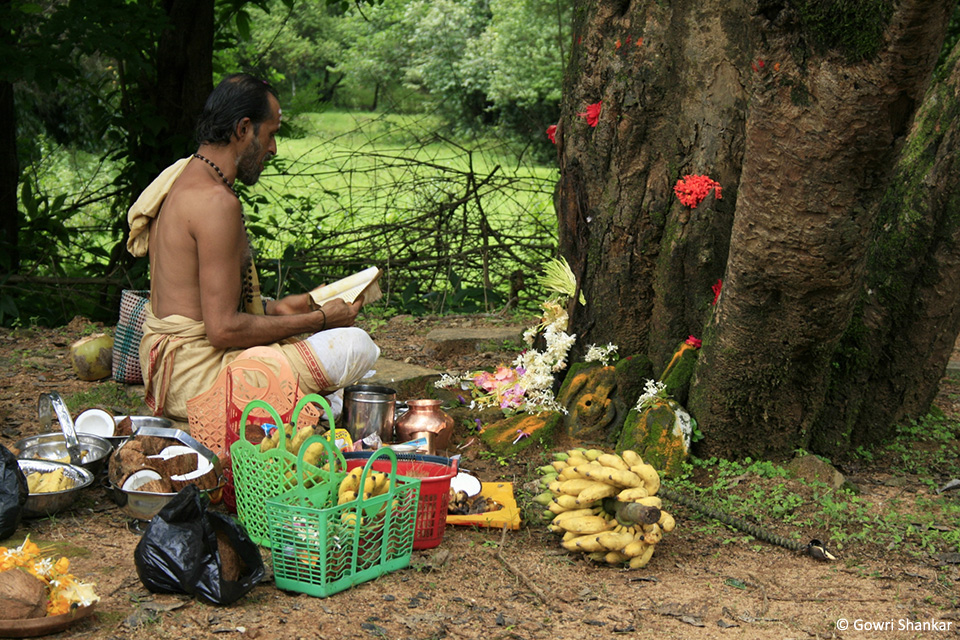
People in Agumbe offer special prayers to the snake god if a King Cobra enters their home.
The King Cobra has earned the title of a king for its own reasons. Apart from growing up to 15 feet in length, these snakes stand their ground when confronted. Their deep sharp gaze highlights their intelligent nature which is also evident in their ways of hunting and avoiding danger. Being excellent swimmers, climbers and fast movers in a wide array of terrains, they have conquered almost every habitat. Their venom potent enough to kill a man 20 times over and an elephant in a single bite commands a respectful distance from rest of the animal kingdom. The ability of this limbless creature to build a well engineered nest and guard it by holding its ground, (a technique that no other snake across the world has mastered) grants an equal status to the queen, and their secretive lives catapults them to a celebrity status, chased by paparazzi (read wildlife photographers, biologists, scientists and adventurous common men).
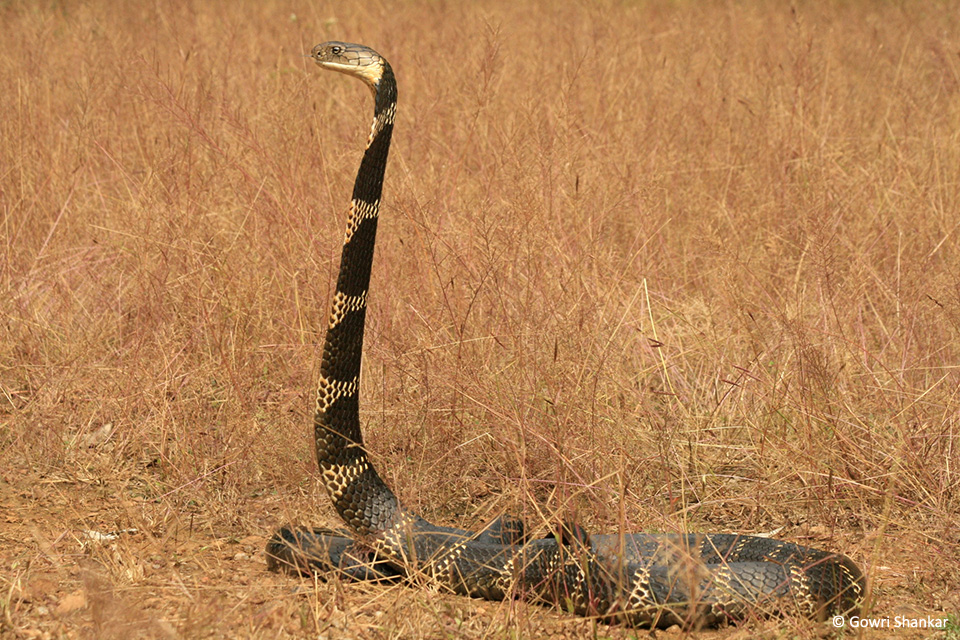
A King Cobra raises one third of its body length while hooding up and standing its ground when confronted.
King Cobra (Ophiophagus hannah) translates to ‘Snake Eating’, where Ophio means snake and phagus means eating. King Cobras are primarily snake eaters, but occasionally feed on monitor lizards. They are known to adopt different strategies while hunting different species of snakes. While preying on a Common Cobra (Naja naja) they move slow and steady and grab the head directly, avoiding any bites from the prey, whose venom is far more potent than their own. However, while hunting a Rat Snake, they are comfortable grabbing any part of the snake’s body, and swallow them alive. During monsoon, finding a cobra or a rat snake becomes tough, and we have observed one radio tagged King Cobra eat 24 Malabar Pit Vipers (Trimeresurus malabaricus) and 2 Hump Nosed Pit Vipers (Hypnale hypnale).
King Cobra grabs a Rat Snake mid body and moves towards its head before swallowing it alive.
Excellent climbers, King Cobras hunt for Malabar Pit Vipers and Rat Snakes even on trees.
Male King Cobras measure an average of 11 ft in length while females average 9 ft. Their breeding season begins from early February and lasts till early April. Size plays an important role. Being cannibalistic in nature, a large King Cobra will easily devour a smaller one, an exception being during the breeding season. Many males vie to mate with a female which results in a sort of a tussle called male combat. Males entangle and fight hard to win over the other through sheer strength. The triumphant male engages in courtship, a silent affair where a male slides over a female butting his head on hers and engaging in tail twitching. They eventually mate where both the male and female (irrespective of their sizes) remain together for days. Being polygamous in nature, many males may mate with a single female.
Two males engage in male combat while a female remains in a burrow close by.
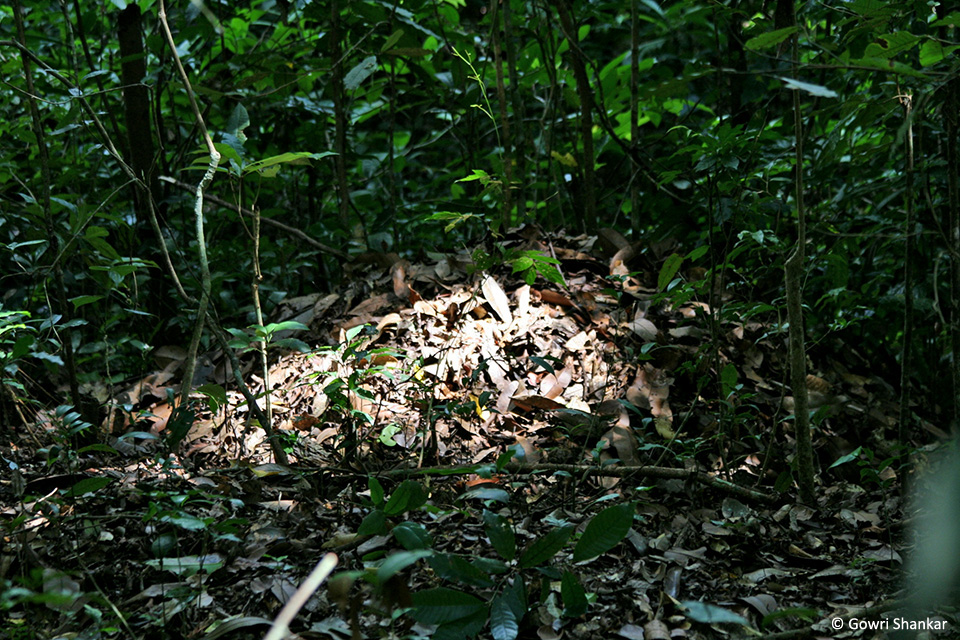
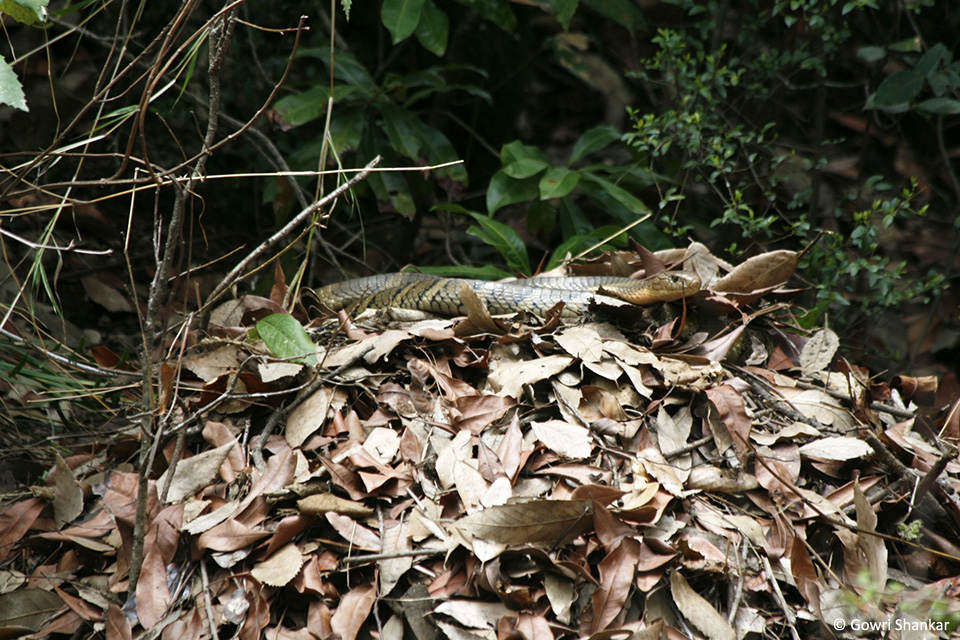
Soon after mating, during late April and mid May, females move away and scout for an ideal nesting site to build their nests, lay eggs, and guard them. They typically choose a slope with tree cover. This ensures good moderation of direct sunlight as well as protection from the deluge of the monsoons set to follow in the coming months. During our observations for over five years, we have seen females stay with the nests for close to 20-25 days after which they abandon their nests and go their way. The females rarely feed while guarding the nests. This is however not the case with King Cobras observed at Uttaranchal and Mizoram. In these mountainous ranges, females have known to guard their nests for over 90 days and leave just before the hatchlings emerge.
The nest receives direct sunlight for a part of the day and the tree cover also ensures protection from rain.
A female King Cobra remains vigilant and alert as she guards her nest.
An average clutch size is around 20 eggs with close to 95% hatching rate. Baby King Cobras come armed with venom, ready to kill as soon as they are born. They remain close to the nest surviving on the remnants of yolk and leave soon after they shed their skin. Very little is known about how these hatchlings reach adult-hood in the wild.

Just out of its egg shell, a newborn king looks ahead at the kingdom it has inherited.
King Cobras across the world face different challenges for survival. Habitat loss and intolerance from people leading to killing feature as the top two. The need of the hour is greater awareness and more research to ensure their conservation.It has been more than a decade now since I began my direct association with these magnificent serpents, and to this day they captivate me. During one intriguing incident at Bannerghatta National Park, I observed the snakes to be very relaxed around their keeper Shivananja, when he was inside their pit. I jumped in too, and as soon as they sensed my presence, they raised their head and advanced towards me, looking directly into my eyes. At the Madras Crocodile Bank Trust, I took care of more than 18 captive bred King Cobras, and at Agumbe I have rescued and relocated close to 200 wild King Cobras. I also observed 5 radio tagged King Cobras, and each of them have their own personalities.
A King Cobra’s world is replete with secrets that are yet to be explored. My passion and gnawing curiosity about these snakes has set me on a journey to gain a deeper insight into their lives. A journey that I love.





Instagram